
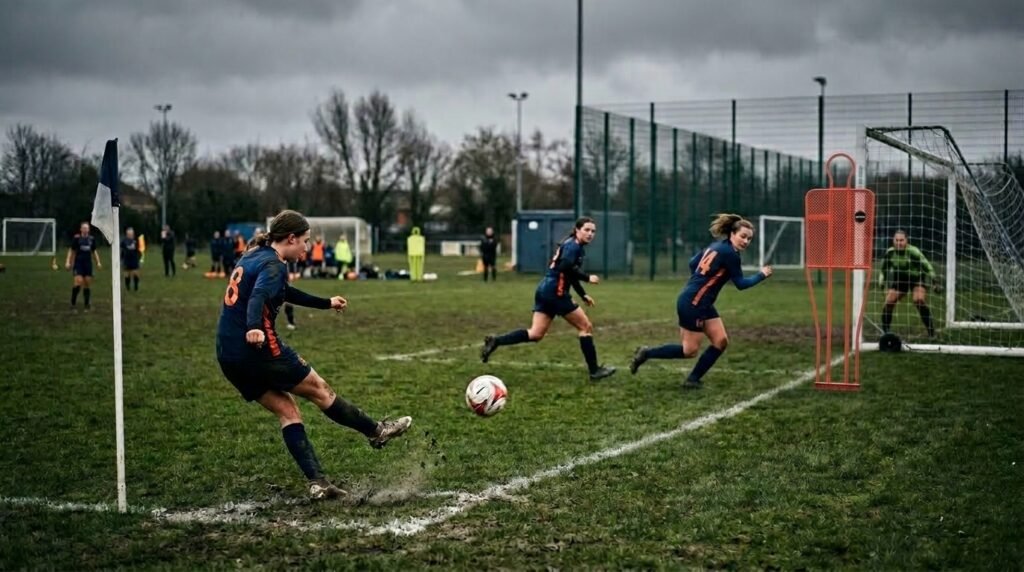
Corner kicks offer a range of tactical options, but deciding between a near post or far post delivery often causes confusion for grassroots teams. Understanding the key differences, pinpointing when to use each approach and working on simple drills can transform your set-piece threat. This guide breaks down the essentials of near post vs far post corners, helping coaches and players gain an edge.
Tactical explanation
Choosing between near post or far post corners starts with identifying your team’s strengths. A near post corner is typically whipped in sharply, aiming for attackers to flick or deflect the ball quickly onto goal. In contrast, a far post corner travels deeper, targeting runners breaking late into space or to exploit defensive gaps.
Advantages of near post delivery
Near post corners rely on pace, surprise and quick reactions. The ball is whipped in low and fast, making it difficult for defenders to clear cleanly. If you have a strong header or a clever flick-on specialist, near post can cause chaos in the six-yard box.
Advantages of far post delivery
Far post corners suit teams with taller players and good aerial presence. By lofting the ball into the deeper area, you create isolation situations where a single forward can outmuscle his marker or meet the ball in space. It also opens angles for cutbacks to the penalty spot.
Why it works in matches
At grassroots level, defenders often lack the organisation and communication seen at higher tiers. A near post corner can exploit indecision as multiple players commit to the flick-on, while others arrive late to pounce. Conversely, a far post corner tests individual defending—you force defenders to track runners into unguarded space without the safety net of a goalkeeper immediately behind them.
Switching between near post and far post deliveries within the same match keeps the opposition guessing. Defenders may overcommit to one side, leaving teammates unmarked. The unpredictability disrupts defensive shape and creates headers towards goal, second balls and scramble opportunities.
Common mistakes
Even the best set-piece plan can unravel through simple errors. Address these frequent issues in training:
- Lack of communication: Attackers and the corner taker must signal delivery type. Without a clear nod or spoken codeword, players hesitate.
- Poor delivery: Under-hitting a far post corner denies attackers time to win the aerial duel. Over-hitting near post streets the ball behind everyone.
- Static runs: Attackers must vary their movement. A stationary near post runner is easily tracked, while overlapping runs for far post can block lines of sight.
- No blocking: Without screening or blocking runs at the edge of the six-yard box, defenders clear with minimal pressure.
Coaching drills
Drill 1: Near Post Flick-On
Setup: Place a central target dummy at the near post, a keeper and three attackers. The corner taker positions normally.
- The taker strikes a driven cross aimed at the dummy’s position.
- One attacker executes a timed run to meet the ball for a flick-on.
- The other two attack the drop or second ball.
Focus on the delivery’s pace, the flicker’s orientation and the secondary runners anticipating the clearance.
Drill 2: Far Post Overload
Setup: Four attackers at the far post, two defenders tracking them and a goalkeeper in position.
- The corner is delivered with sufficient loft and pace to reach the far post zone.
- Attackers make staggered runs: two aiming to jump first, two late runs for rebounds.
- Defenders mark tightly, while the keeper reacts to the cross.
Emphasise timing of runs and weighted delivery to land between the first and second defender.
Drill 3: Mixed Corner Practice
Setup: Full corner setup with five attackers and five defenders. Rotate delivery type between near post and far post.
- Corner taker calls “near” or “far” before each kick.
- Attackers adjust their starting positions and runs accordingly.
- Defenders organise on the fly, practicing communication and marking assignments.
This drill reinforces decision-making under pressure and builds match-like intensity.
Key takeaways
- Near post corners exploit speed and surprise; far post corners rely on height and space.
- Clarity in communication and pre-planned runs ensure attackers meet the ball effectively.
- Vary deliveries within the same game to disrupt defensive organisation.
- Regular drills focusing on delivery accuracy, timing and blocking runs sharpen set-piece execution.
- Analyse your squad’s strengths—choose the corner type that aligns with your best headers and runners.
FAQ
Should I always alternate between near post vs far post corners?
Alternating keeps opponents unsettled, but you should favour the type that suits your strongest headers and delivery quality. Practise both, then use match context to decide.
How many players should attack a near post corner?
Ideally two: one to flick on at the near post and another to attack the second ball around the penalty spot. Position backups outside the box to prevent breakaways.
What’s the best way to coach blocking runs?
Use mannequins or cones to simulate defenders and assign one attacker to screen or impede them at the near post. Focus on timing to avoid fouls while disrupting the opponent’s path.