
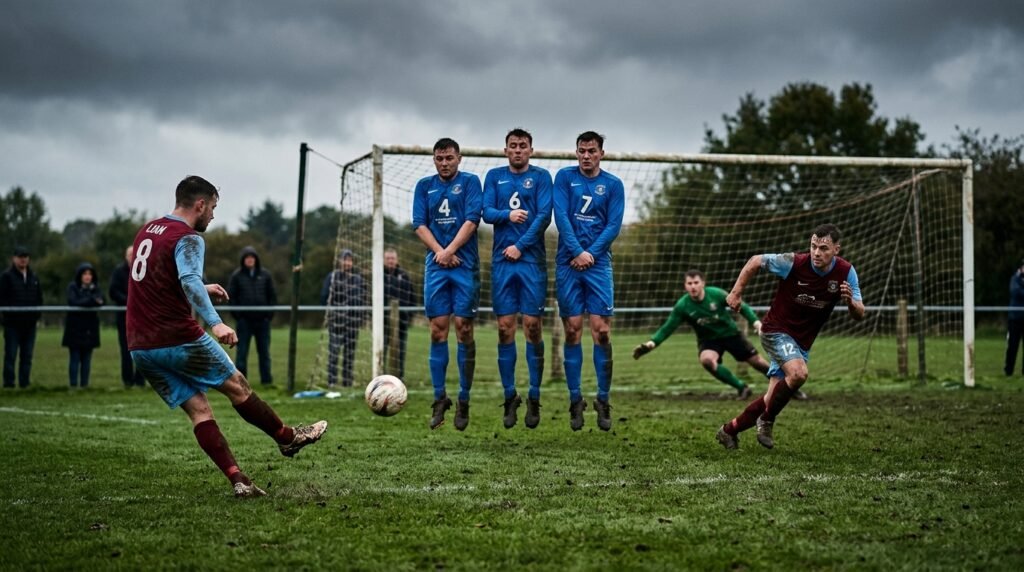
Set-piece situations can change games at grassroots level. With simple structure and well-rehearsed moves, your team can turn a dead-ball into a real threat. These free kick routines football strategies are designed to suit 7v7 or 11v11 formats, focusing on clear roles, movement and precision.
Tactical Principles of Free-Kick Routines
Every effective free kick routine shares common tactical threads: movement to create space, misdirection to unsettle the defence and accurate delivery. At grassroots level, defenders often line up quickly and rely on brute force rather than organisation. By practising set plays where attackers knowing exactly when and how to move, you force hesitations and gaps in the wall.
Why it works in matches
Defenders in casual or youth football rarely drill specific set-piece marks. A well-timed dummy run or a disguised pass exploits that lack of discipline. Consistency in routine execution also builds confidence. When players know their roles by heart, they can focus on technique rather than second-guessing.
Routine 1: Wall Split with Dummy Runner
This down-and-under or “Ollie” move confuses the defensive wall and keeper, creating an opening for a low driven shot.
Setup
- Place two or three attackers in a tight line facing the ball, about 10 yards out.
- Defensive wall should be 9.15 metres (10 yards) away.
- Designate one player as the kicker, one as the dummy runner and one at the posts for rebound.
Execution
- On the kicker’s approach, the dummy runner charges forward to drag a wall defender out of position.
- The kicker strikes low and hard under the leaping wall, aiming for the gap.
- The third player follows up on any rebound or block.
Coaching Drill
Set up cones to simulate a three-man wall. Allow defenders to practice lifting arms to block. Attackers rehearse the timing: first five reps at half pace, next five at full power. Emphasise communication: the dummy runner calls “now” to synchronise movement.
Routine 2: Short Lay-Off and Cross
A short pass to a nearby teammate opens up angles for a drilled cross or smash at goal.
Setup
- Position kicker and a second player two yards to the side.
- Other attackers line up at the penalty spot and edge of box.
- Goalkeeper should prepare for quick changes in ball direction.
Execution
- Kicker plays a firm pass to the lay-off man, who turns swiftly and delivers a curling cross to the penalty area.
- Attackers time their run to meet the ball on the rise.
- Optional: second dummy run distracts one or two defenders near the kicker.
Coaching Drill
Pair up players for 10–12 m passing practice, then add two defenders to shadow. Switch roles so everyone practices the lay-off and crossing. Encourage defenders to communicate and recover quickly, making attackers refine the speed and weight of passes.
Common Mistakes and How to Avoid Them
- Poor Communication: Attackers must call for movement. Silence leads to mistimed runs.
- Overcrowding: Too many players in one spot reduces shooting lanes. Limit routines to three or four key participants.
- Lack of Variation: Using the same move repeatedly becomes predictable. Rotate routines in training sessions.
- Wrong Distance: Free-kick takers often stand too close or too far. Mark the sweet spot at 8–12 yards in training.
Key Coaching Drills for Free-Kick Practice
1. Wall Evasion Drill
Place a two-player wall (cones or mannequins). Kickers try low-driven shots under the simulated wall. Rotate kicker, dummy and rebounder every five attempts. Focus on accuracy and timing.
2. Quick Tap and Cross Drill
Two attackers face each other at 10 yards. One plays a short pass and makes a run toward the box, the other swings in a cross. Defenders shadow for real-game pressure.
3. Mixed Routine Rotation
Set up three stations, each featuring one free kick routine. Teams of five run each station for five minutes, then rotate. Keeps sessions dynamic and encourages muscle memory for multiple routines.
Key Takeaways
- Free kick routines football success hinges on repetition and clarity of roles.
- Use no more than four participants in any routine to maintain space and timing.
- Drills should mimic match conditions: add defenders, vary distances and enforce communication.
- Mix up the routines to prevent predictability and keep the opposition guessing.
- Review each session: film the drills, identify mistakes, and correct them immediately.
With these simple yet effective free kick routines football teams can gain an edge in set-piece scenarios. Consistent practice under realistic pressure will see your grassroots side convert more opportunities and tighten up defensively.