
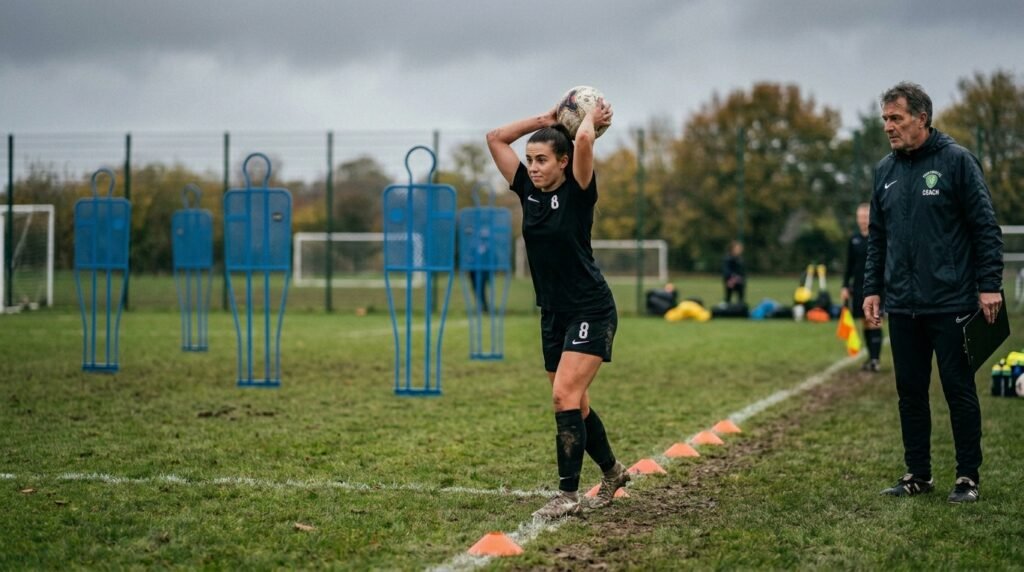
Executing a legal throw-in technique is a key skill at grassroots level, allowing teams to maintain possession and launch attacks from the touchline. Proper mechanics, body position and tactical awareness all contribute to a throw-in that meets the rules while offering your side an advantage. This guide breaks down each element, explains why it works, highlights common errors and provides practical drills you can use in training.
Tactical explanation
A well-taken throw-in does more than simply return the ball to play. It can act as a spare touch for defenders, stretch opposition shape and create overloads near the sideline. The technique relies on three core principles: feet placement, arm action and body rotation.
First, both feet must stay on or behind the touchline. The throwing player should face the field of play, with shoulders square to the target area. Next, the ball is brought from behind and over the head in one continuous motion, using both hands equally. Finally, a slight lean over the pitch ensures momentum carries the ball forward.
By combining a quick release with accurate direction, you can feed a team-mate in space or send a long throw into the penalty area. Targeting a runner makes it a dynamic attacking weapon, especially if defenders hesitate to mark tightly.
Why it works in matches
Using the legal throw-in technique effectively can disrupt an opponent’s defensive shape. Short, sharp throws allow your side to recycle possession and shift the point of attack, forcing the opposition to adjust their line. Longer throws, delivered accurately, create aerial duels in and around the penalty box, akin to a corner kick.
In transitional phases, a rapid throw-in from a thrower with good body orientation speeds up play and catches defenders off guard. Defenders often expect a cross or simple lateral pass; instead, a well-executed long throw can land behind them, offering an unmarked team-mate a chance to attack the ball.
This dual threat—quick link-up or aerial contest—means defenders must respect both options, creating space elsewhere on the pitch. It also keeps your side on the front foot, maintaining attacking momentum.
Common mistakes
Even experienced players can slip up on throw-ins. Address these errors to ensure compliance and effectiveness:
1. Feet off the line: Lifting or stepping over the touchline leads to a foul throw. Emphasise proprioception so players feel the line with their toes.
2. Incorrect arm movement: Stopping the ball halfway or using one hand invalidates the throw. Drills should focus on a continuous motion.
3. Poor body alignment: Twisting the torso away from the field reduces accuracy. Encourage players to face the target directly.
4. Telegraphed throws: Holding the ball too long gives defenders time to close down. Practice quick release under pressure.
5. Imbalanced follow-through: Leaning back reduces distance and precision. Stress a forward lean at release.
Coaching drills
These drills develop the technical, tactical and physical elements of the legal throw-in technique.
Foot line awareness drill
Place one-metre markers along the touchline. Players practise throwing without stepping on or over the markers. Start static, then add a defender lightly pressing from behind. Encourage players to sense the line with their toes before every throw.
Two-touch target practice
Form pairs five metres apart. One player throws; the receiver controls with their first touch and passes back with their second. This combines accuracy in the throw with receiving skills. Switch roles after 10 throws each.
Quick-release under pressure
Divide into two lines near the touchline. The first player in each line holds the ball; a defender is 2–3 metres ahead. On coach’s whistle, the thrower must execute a legal throw to their team-mate while under light pressure. Defenders increase intensity progressively.
Long throw into the box
Set up mannequins or lightly contested defenders in the penalty area. The thrower stands on the touchline 25–30 metres out. Practice full-body throws aiming for a specific zone (near post, central channel or back post). Rotate throwers to work on shoulder and core strength needed for distance.
Game-situation overloads
In a small-sided game, award extra points for breakaways or goals originating from throw-ins. Encourage players to use both short and long throws tactically. Adjust field size and team numbers to create 3v2 or 2v2 situations around the sideline.
Key takeaways
– Always keep both feet on or behind the line and face the field of play.
– Use a continuous over-the-head motion with both hands to ensure legality.
– Combine accuracy and quick release to challenge opponents tactically.
– Practise under pressure and in match-like scenarios to build confidence.
– Mix short, precise throws with longer, aerial options to maintain unpredictability.
FAQ
1. How should I position my feet for a legal throw-in?
Place both feet on or behind the touchline, parallel or staggered. Ensure neither foot lifts or crosses the line during the throw.
2. What’s the best way to add distance to a throw-in?
Generate momentum through a slight run-up, full-body rotation and a forward lean at release. Strengthen shoulders and core to support longer throws.
3. Can I feint before a throw-in?
No. Feinting after approaching the line is illegal and will result in a foul throw. Instead, focus on disguising throw direction with minimal body movement.