
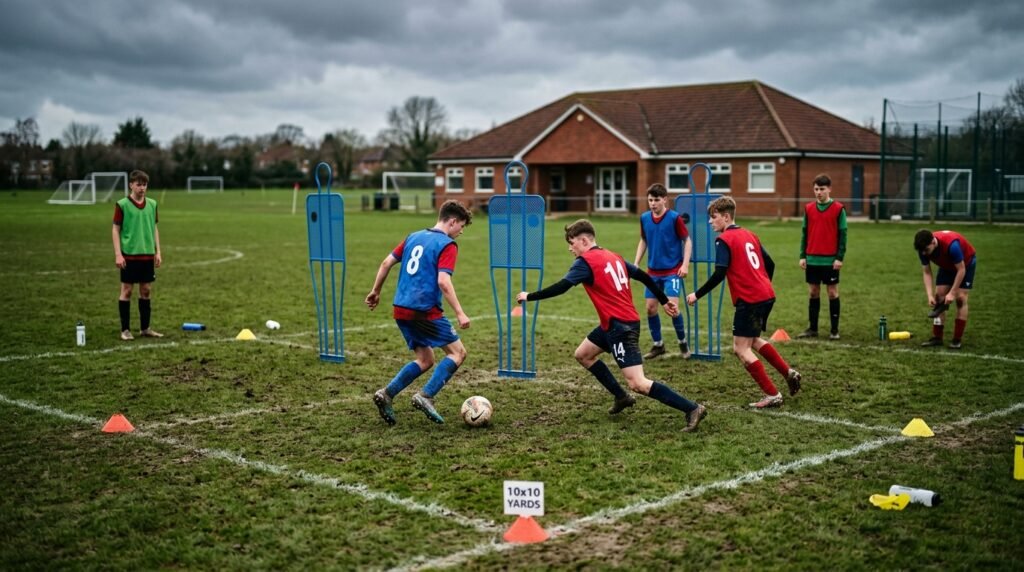
Effective set-piece organisation can turn dead-ball situations into scoring opportunities and defensive strongholds. Grassroots teams often overlook the tactical nuances that underpin successful corners, free-kicks and throw-ins. This guide covers practical set piece training drills to help coaches instil clear roles, timing and movement patterns in their players.
Tactical explanation
Organised set pieces rely on predefined routines that players understand without hesitation. Attackers run specific routes, blockers shield opponents, and the delivery is precise. Defensively, teams form walls, mark zonally or man-to-man, and maintain a clear structure to repel threats. By practising these scenarios, players build muscle memory, minimise confusion and gain the confidence to execute under pressure.
Why it works in matches
In competitive games, set pieces account for a high proportion of goals. Trained routines catch opponents off-balance, exploit space and create mismatches. Defensively, rehearsed organisation reduces panic, limits clear shots on goal and forces opponents into low-percentage attempts. Consistent practice means players know exactly where to stand, when to move and how to coordinate with team-mates, giving your side a decisive edge.
Common mistakes
One of the most frequent errors is lack of communication. Players fail to call for the ball or alert team-mates to runs behind the defence. Poor timing also costs opportunities: a delivery that arrives too early or late leaves attackers static. Misaligned walls or zonal gaps invite easy shots. Additionally, neglecting variation makes routines predictable. Finally, insufficient practise of both attacking and defensive roles leads to uncertainty when it matters most.
Coaching drills
1. Defensive Wall Drill
Set up a free-kick scenario with a simulated wall of three to five players and a kicker. The coach shouts “go” to start the drill. The wall must form immediately on command, align shoulder-to-shoulder, and jump in sync when the ball is struck. Rotate players so each takes turns in the wall, marking, and kicking. This drill sharpens communication, alignment and timing.
2. Attacking Corner Routine
Use half a pitch with corner flags and six to eight attackers. Assign roles: two edge players at the near post, one at the far post, blockers too. The corner delivery comes in from a coach or player. Attackers run rehearsed routes—near post dummy runs, late arrivals at the edge of the box. Rotate deliveries between inswingers and outswingers. Focus on timing, blocking defenders legally and making the right run for the ball.
3. Free-kick Delivery and Runs
Lay out cones to represent defensive walls and landing zones. Split players into takers and runners. Takers practise bending the ball over or around the wall, targeting spots near the penalty spot or corners of the six-yard box. Runners practise timed breaks from two distances—just behind the wall and from the edge of the box. The aim is synchronising delivery and movement to exploit gaps. Encourage varied runs: straight at the wall, diagonal cuts, and dummy decoys.
4. Late Runner Overload Drill
Position six outfield players centrally and two defenders. The coach feeds balls into the box, with two attackers starting wider. Defenders mark the central players. After two touches, the wide players make late runs into the penalty area to attack the cross. This simulates overloads in crowded boxes and trains defenders to track runners at the last moment.
5. Throw-in Zones and Short Plays
Divide the sideline into three zones. Assign short throw routines: quick short to the adjacent midfielder, switch to the full-back or long throw into the box. Practise variations on restart speed, body shape for deception and overlapping runs. This drill sharpens timing, deception and decision-making under pressure.
Key takeaways
- Plan set-piece roles clearly: assign blockers, runners and finishers.
- Rehearse timing: ensure deliveries and runs are synchronised.
- Vary routines: inswingers, outswingers, short throws, wide free-kicks.
- Defensive structure: align walls, mark zones, communicate constantly.
- Rotate positions: give every player experience in both attacking and defensive duties.
FAQ
Q1: How often should I include set piece training drills in sessions?
A1: Aim for one dedicated 15–20-minute block per week, plus a couple of five-minute refreshers in other sessions to maintain sharpness.
Q2: Can beginners handle complex routines?
A2: Start simple—one run and one delivery. Once they master basics, layer in blockers, decoys and multiple run options step by step.
Q3: How do I simulate realistic match pressure in training?
A3: Add defenders and a goalkeeper, impose time constraints or score the session. Encourage competition by rewarding successful executions with small prizes or team points.