
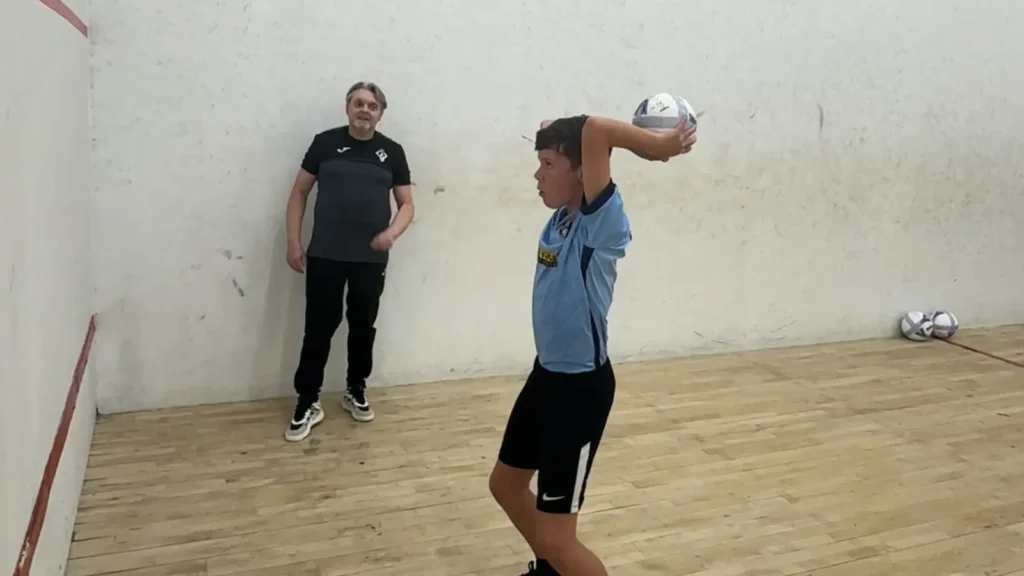
This is a 20-minute throw-in session you can run with any U8 to U12 team. All you need is a solid wall, a few cones and some heavy balls. Run it twice a week and your players will throw further, take fewer foul throws, and you’ll find out who your long thrower is.
What you need
- A solid wall. A clubhouse wall, a school wall or a rebound board.
- One heavy ball for every 2 or 3 players. Four balls cover a squad of 10 to 12.
- Normal match balls for the target drill.
- Cones and a tape measure for the distance test.
A heavy ball is a normal football with water inside. Here’s how to fill a football with water. The washing-up liquid is what keeps it bouncing back off the wall.
How heavy should the balls be?
Use the ball size your team plays with in matches and start at the lightest weight.
| Age | Ball | Start | Max | Sets x reps | Rest |
|---|---|---|---|---|---|
| Under 10 | Size 3 | 1 kg | 2 kg | 2 to 3 x 4 to 5 | 90 to 120 secs |
| 10 to 13 | Size 4 | 1.5 kg | 3 kg | 3 x 4 to 6 | 90 secs |
Only move a player up when every throw is clean. If their back arches or their feet come off the ground, the ball is too heavy.
The 20-minute session
1. Warm-up (3 minutes)
Arm circles, shoulder rolls and gentle trunk twists. Keep it easy. The point is to get the shoulders and back moving before any throwing.
2. Legal throw check (3 minutes)
Players pair up with a normal ball and take 5 throws each to their partner. The partner checks three things:
- Both feet stay on the ground
- Both hands on the ball
- The ball comes from behind the head
Most foul throws at this age come from lifting the back foot or throwing with one hand. Fixing it now stops you losing the ball on a Saturday.
3. Heavy ball wall throws (8 minutes)
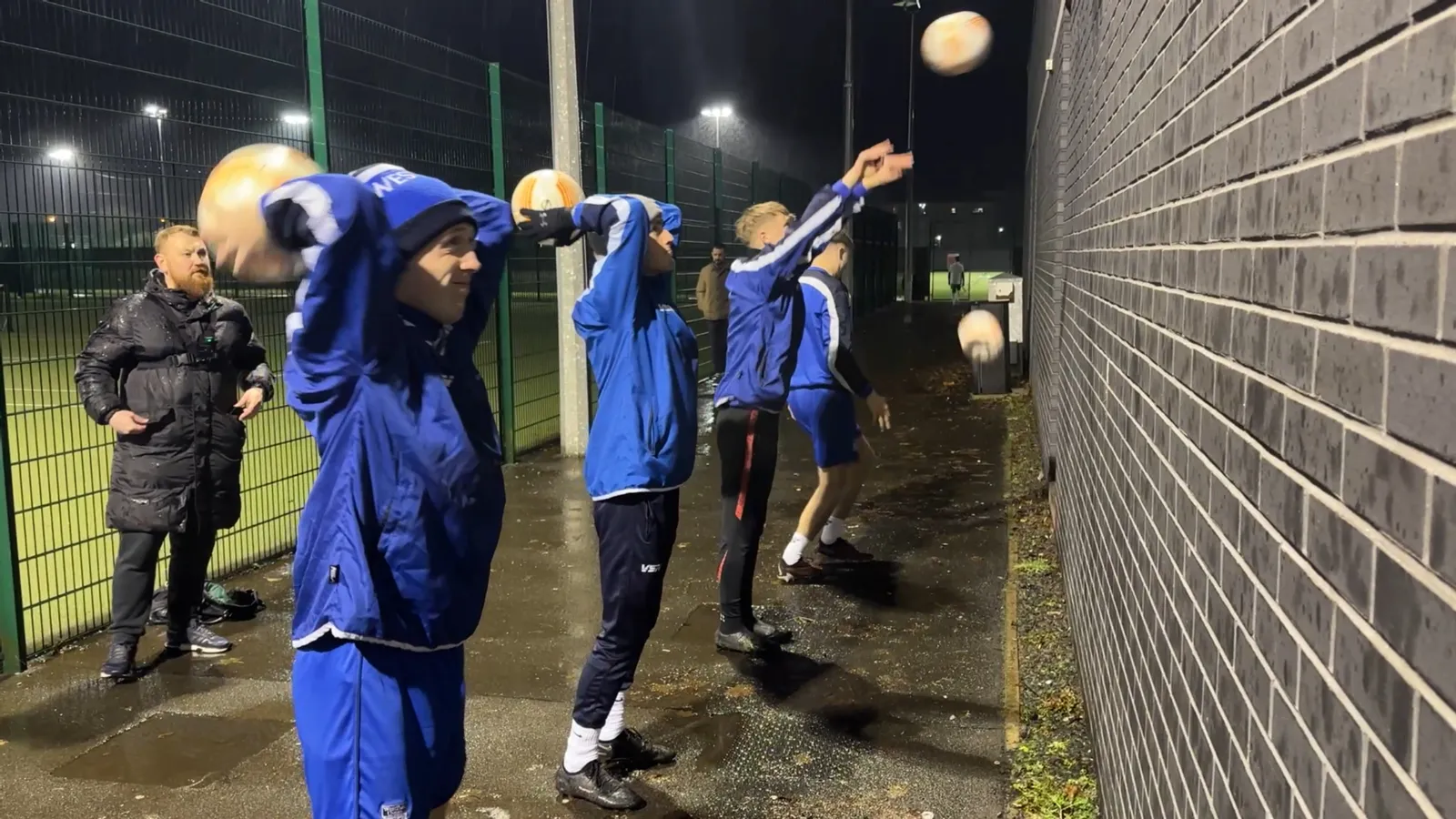
This is the part that builds distance. Split into groups of 2 or 3, one heavy ball per group, standing a few metres from the wall.
- One player throws their set against the wall while the others rest.
- The ball bounces back, so there’s no chasing it.
- Rotate after each set. With 2 or 3 in a group, the rest takes care of itself.
Use the sets and reps from the table. Quality over quantity: a few clean throws do more than lots of sloppy ones.
Coaching points: power comes from the legs and core, not just the arms. Ball back behind the head, then release in front of it and follow through.
4. Target throws (4 minutes)
Back to normal match balls. Put out a cone target, or a partner, at a distance most players can just about reach. Players take turns throwing at it. After the heavy ball, the normal ball feels light, and you’ll see it go further straight away.
Make it a game. A point for hitting the target, and move the cone back when someone does.
5. Distance test (2 minutes, every 2 weeks)
Every second week, finish with a quick test. Each player takes one throw from a line with a normal match ball. Measure where the ball first lands and write it down.
This is how you find your long thrower, and it shows the kids they’re improving, which keeps them keen.
How often to run it
Twice a week, at the start of training when players are fresh. 10 to 20 minutes is enough. Don’t run heavy ball throws on back-to-back days.
Common mistakes
- Starting too heavy. Always start at the lightest weight for the age group.
- Too many reps. Stick to the table. Tired throws are bad throws.
- Skipping the technique check. Extra power with a foul throw is still a foul throw.
Run this with your whole squad
The Coach Package gives you a Tap Adapter to make the heavy balls, a 4-week plan built for your team’s age group, a progress tracker, and me on WhatsApp for 6 months to help with anything you’re unsure about.
FAQ
How heavy should the ball be for an 8-year-old?
Start at 1 kg with a size 3 ball. Go up slowly, to a maximum of 2 kg, and only when every throw is clean.
Can we do this every training session?
Twice a week is plenty. Avoid heavy ball throws on back-to-back days.
What if we don’t have a wall?
Players can throw the heavy ball to a partner instead. It takes longer because the ball doesn’t come back on its own, so use bigger groups.
How many heavy balls do I need?
One for every 2 or 3 players. Four balls cover a squad of 10 to 12.