
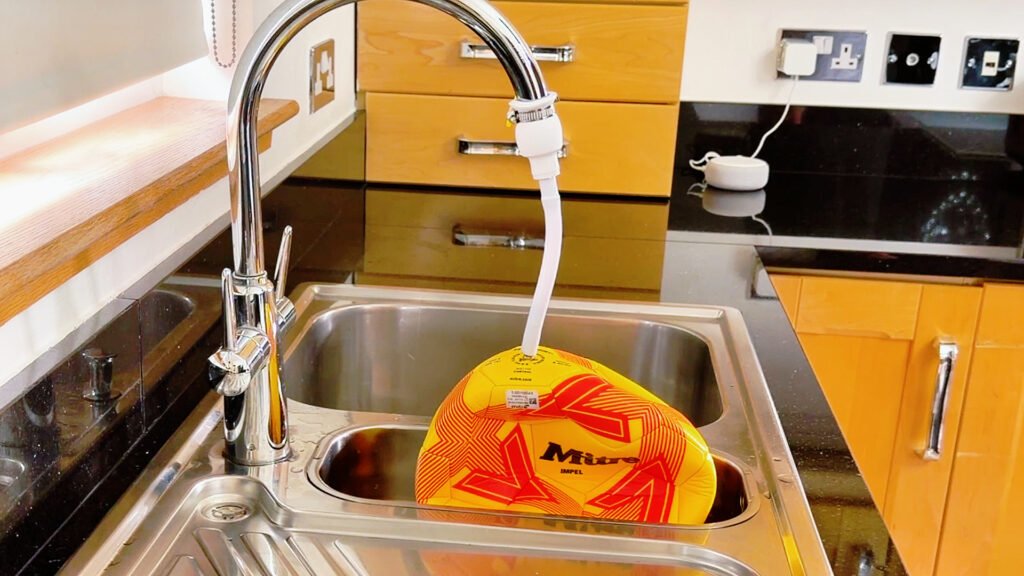
If you’ve searched for how to fill a soccer ball with water, you’ve probably seen the washing-up liquid trick — a squirt of soap, a good shake, and the foam is meant to stop the water sloshing around. It sounds clever. In practice, most players who try it end up with a ball that still doesn’t behave, or a valve that’s damaged within a few sessions.
Why the DIY washing-up liquid hack usually goes wrong
The foam trick helps a little, but it doesn’t actually solve the problem. Force water through a valve that isn’t designed for it and you risk a leaky valve, a damaged bladder, or an unbalanced ball where the water still shifts mid-throw no matter how much you shake it first.
The sloshing, unbalanced ball problem
Even with foam, water finds the path of least resistance. Throw a ball that isn’t filled properly and the weight can shift mid-motion, sending the ball off-target and making every rep feel different from the last one. That’s the opposite of what you want from training — you’re trying to build a consistent movement, not fight an unpredictable ball.
The risk to your shoulder and elbow
An unstable, sloshing ball puts uneven load through your arm on release. Do enough reps like that and you’ll feel it — niggling strain in the shoulder or elbow that doesn’t show up after one throw, but builds up over a few sessions. If the ball doesn’t move like a real football, you’re not getting the training benefit — you’re just risking an injury that sets you back further than any DIY hack saves you.
The right way to fill a heavy ball
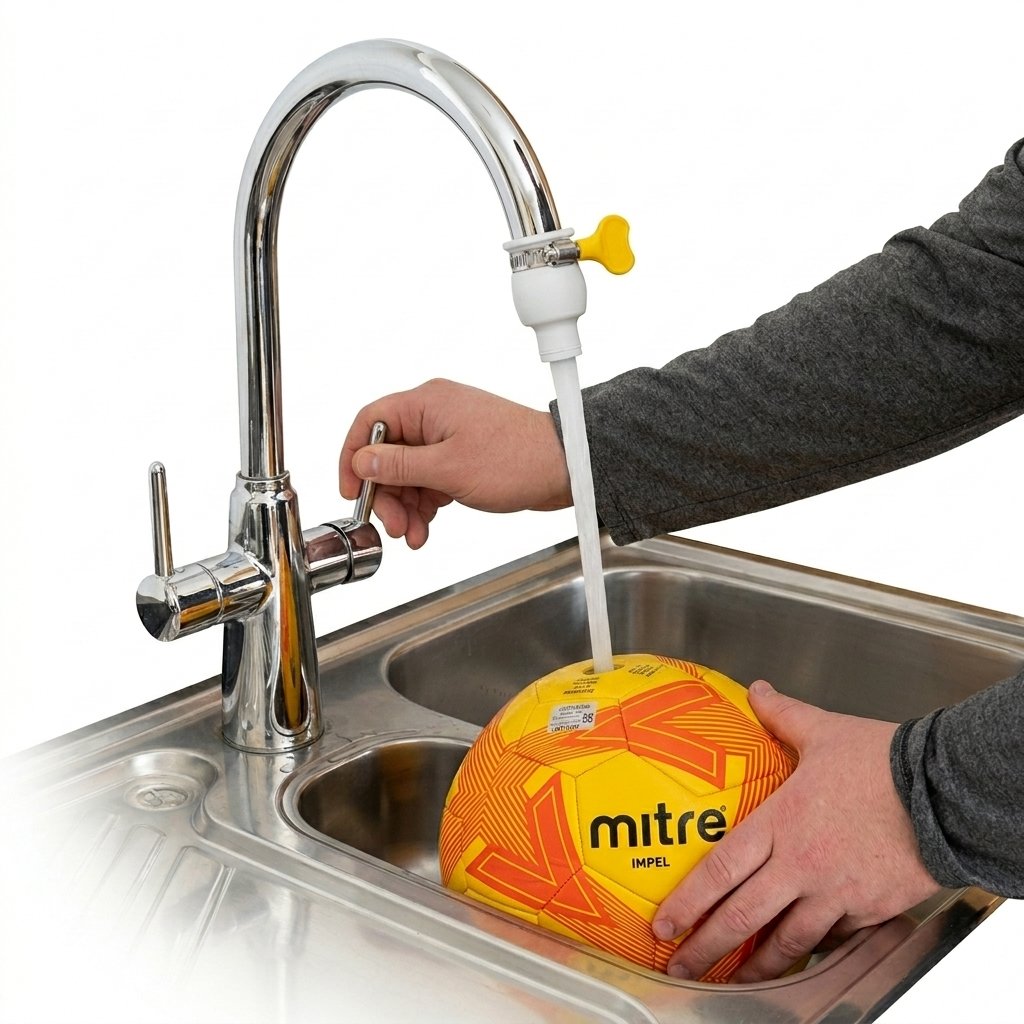
You still do this at your kitchen sink or an outside tap — no special skills needed. The Long Throw Coach Tap Adapter connects directly to any standard household tap and fills your ball in under two minutes, with zero damage to the valve. No washing-up liquid, no guesswork, no leaks.
A two-minute setup, done properly
Push the adapter onto the valve, connect it to the tap, and let it fill. The seal keeps the pressure even so the bladder isn’t stressed and the valve stays intact — the two things that go wrong most often with DIY methods.
Correct weights by ball size
- Size 3 — 3kg
- Size 4 — 4kg
- Size 5 — 5kg
Why a water-filled football beats a medicine ball
A medicine ball builds strength, but it doesn’t train the actual throw-in movement. A properly filled football keeps the same size, shape and touch as a match ball, so every rep transfers directly into your game.
The same feel as a matchday ball
Because it’s the same size and shape as the ball you play with, your hands and technique don’t have to adjust to something unfamiliar. You’re training the exact movement you’ll use on Saturday, just with more resistance.
It bounces — so you can train alone
A medicine ball just thuds and stops. A properly filled football still bounces, which means you can do rep after rep off a wall with no partner needed. That’s what makes it realistic to actually stick to a training routine twice a week.
Picking the right ball
Use an old standard training ball — not a high-end thermal-bonded match ball, which is built differently and doesn’t take to this kind of use. A worn but intact training ball is ideal: cheap to dedicate to heavy-ball work, and tough enough to handle the extra weight without the seams giving out.
Fitting the adapter
The adapter has a universal multi-fit design that works with standard garden taps and indoor mixer taps, creating a watertight seal so the ball fills correctly every time.
Adjusting the weight as you progress
You can add or remove water to change the weight between sessions. Start lighter, build up gradually over a couple of weeks, and back off if your throwing technique starts to break down under the extra load.
The result
Training with a heavier ball forces your muscles to work harder to produce the same movement. Switch back to a standard ball afterwards and it feels effortless — that contrast is where the extra distance comes from. Most players train twice a week and notice a difference within two weeks.
Get the Long Throw Coach Tap Adapter + Training Videos — £29.99 with free UK delivery.
FAQ
Can I put water in any soccer ball?
Most standard synthetic-leather training balls take water fine. Avoid high-end thermal-bonded match balls — the construction is different and they don’t hold up the same way. Use an old training ball you don’t mind dedicating to heavy-ball work.
What do I need to fill a ball safely?
A proper tap adapter that seals around the valve, like the Long Throw Coach Tap Adapter. It fills the bladder without forcing or stretching the valve, which is what causes leaks and damage with DIY methods.
How much water should I add?
Start light and build up. Fill a little, test a few throws, then add more if you want extra resistance. If the ball ever feels like the weight is shifting inside, it’s not filled correctly — drain it and refill properly rather than trying to compensate.
How do I avoid leaks or a damaged bladder?
Never force a hose or improvised tool directly into the valve. A proper adapter seals around it and fills under control, so the bladder isn’t put under uneven pressure. Don’t overfill — you want some air left inside so the ball keeps its shape and bounce.
How should I train with it, and how quickly will I see results?
Train twice a week, doing reps off a wall to build the fast-twitch power behind a long throw-in. Most players notice a difference within two weeks. If the ball ever feels unstable during a session, stop and check the fill rather than pushing through it — shoulder and elbow strain almost always comes from an unbalanced ball, not from the training itself.